Inside the mind of
Kavya Sree Kammari
0 × 0
AI Engineer & Researcher I build agents that think, sense and act in the world
Get in touch
Hi, I'm Kavya.
Platform engineer at SAP, building the thing that lets anyone create AI agents in a few taps. I’m also deep in robotics — I built a home bot that moves around and does things autonomously. Learning new things is just my dopamine.
I build
systems.
I decide. AI executes. That’s the vision — intelligence that works on your command, not the other way around.
4+ years.
Still learning. Still curious.
I got into AI because I watched it transform the world during COVID. That was my cue.
Since then I learn by building — a home robot that moves and reasons, agentic pipelines, RAG systems at scale. If I can’t make it work in the real world, I don’t really understand it yet.
My obsession lives in the gap between impressive demos and real deployments.
A benchmark score tells you it can pass a test. I want to know what happens after — in the wild, with messy data, real users, and edge cases nobody thought to write down.
I build for embodied intelligence. Robots included.
Robots are genuinely cool — yes, that’s reason enough. But also, the hardest AI problems show up when your model has to act in a physical space it can’t fully see. MAVRIM taught me that.
I care about interpretability as much as capability.
Training a model that scores well is the easy part. Understanding why it makes a decision, and where it will fail, is where the real work is. Not because it's required, but because it's what separates research from engineering theatre.
I’d rather understand why it decided.
I don't believe in AI hype that can't survive a real dataset.
I don't believe in vague.
I believe in systems with a why: agents that are interpretable by design, built by people who give a damn about the failure modes no one thought to test.
That's what I build.
That's what I ship.
If you're building something that deserves to work in the real world, let's talk.
I’m open to research roles, AI engineering, and good conversations — coffee, chess, or Rocket League. I’m plat rank. Come at me.
Based inBengaluru.
Andhra Pradesh by roots, Bengaluru by address. When I’m not at the keyboard, you’ll find me playing chess, watching Jensen Huang interviews, staring at the night sky, or climbing the Rocket League ranks — currently plat, working on it.
Selected work
Things I’ve built, researched and shipped — from a home robot to a telescope scheduler. By day I’m a platform engineer on SAP Joule Studio, where I don’t just build agents — I build the product that lets users create their own agents in a few clicks.
I also write about AI at techmyway.hashnode.dev and there’s more on GitHub.
A robot that actually moves around and does things
MAVRIM — Memory-Augmented Vision-language Reasoning Intelligent Mobile Manipulator. A home robot built on agentic AI and embodied intelligence. It plans, moves, and acts in a physical space, because the hardest AI problems only appear when your model has to navigate a world it can’t fully see.
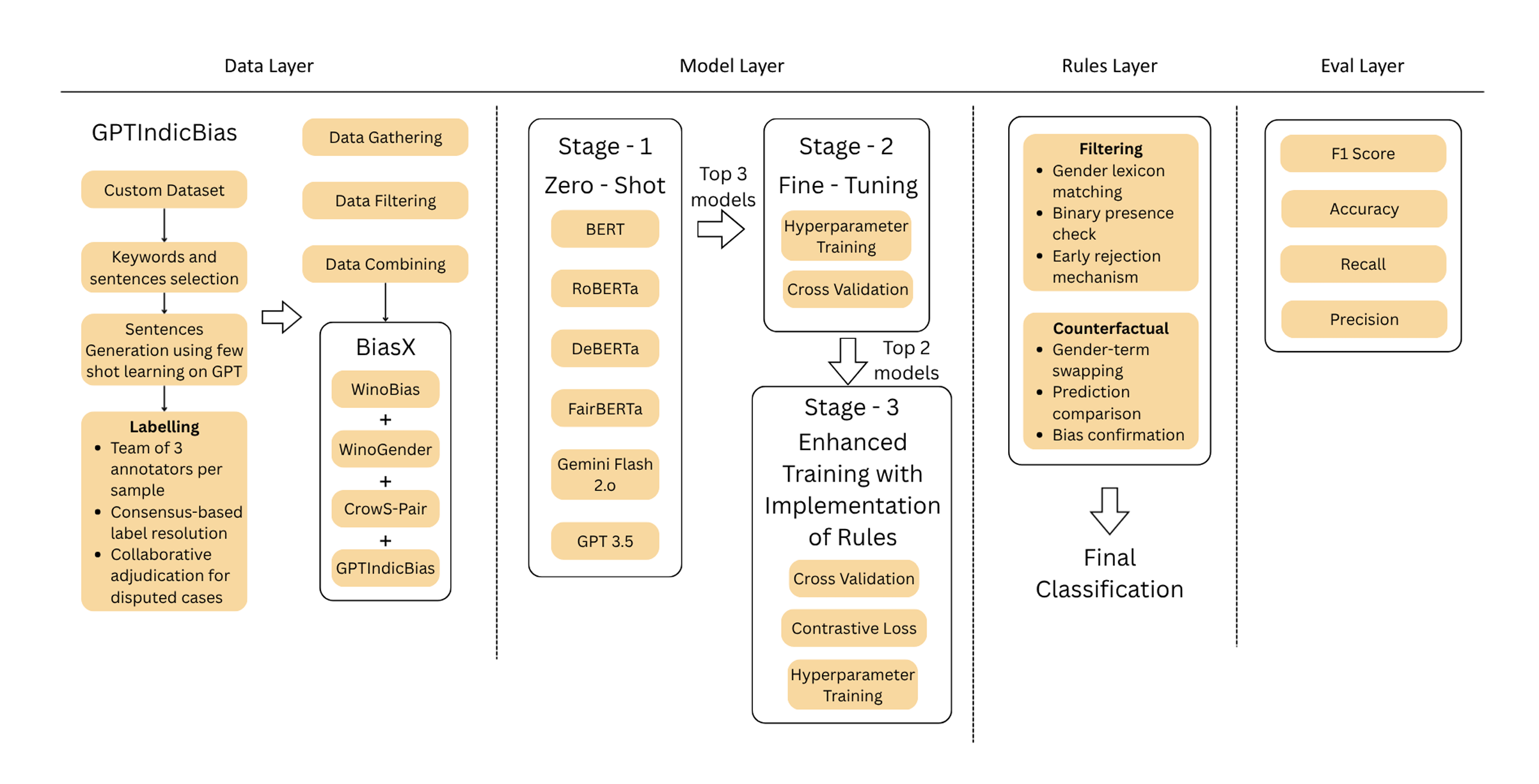
Bias is everywhere — clean the data first
GenderLens hunts gender bias in the text we learn from, starting with textbooks. Nearly 70% of the data carried bias, so it cleanses the source: custom bias corpora, zero-shot screening across six LLMs, fine-tuning, and rule-based counterfactual checks.
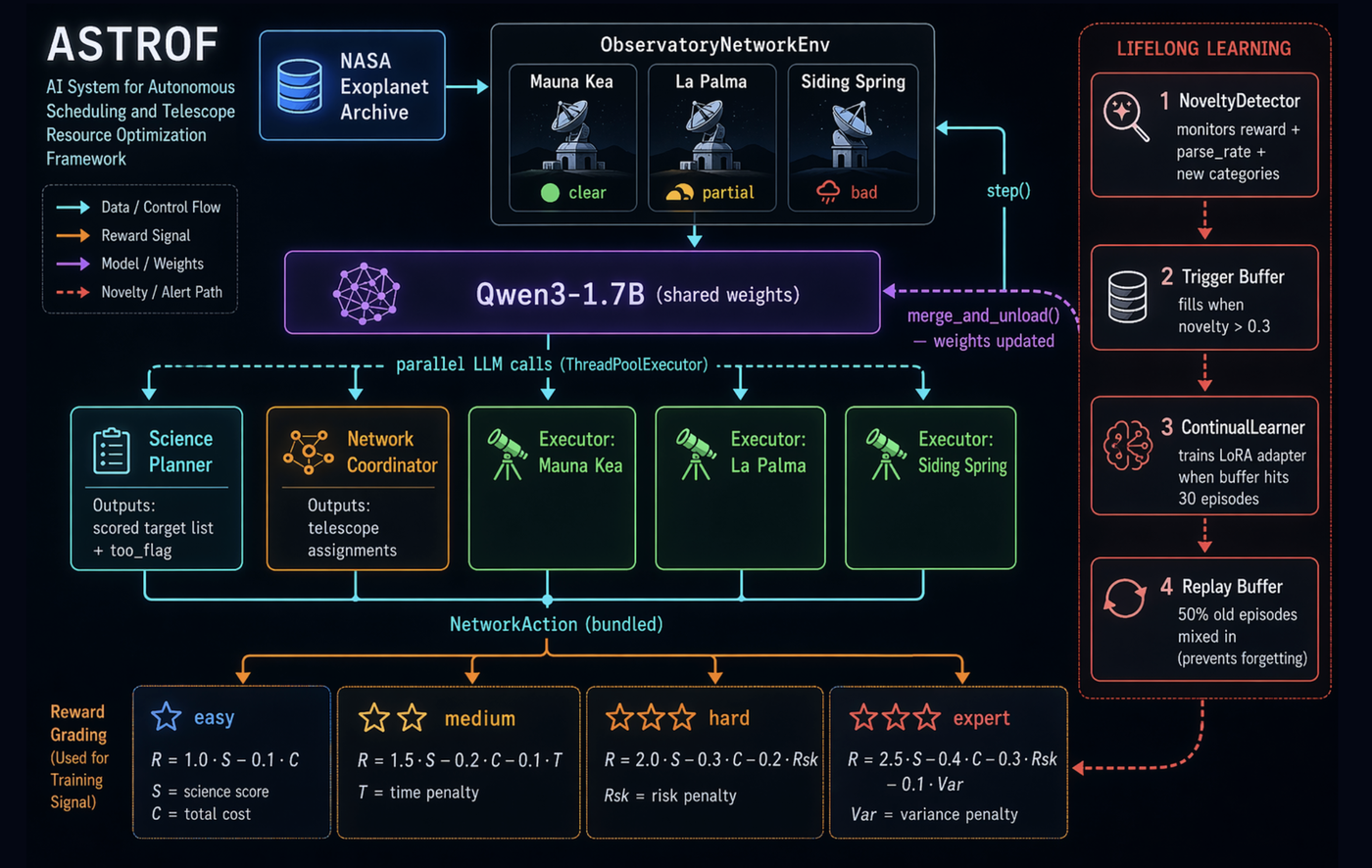
Teaching an agent to run a telescope
ASTROF — an OpenEnv environment for autonomous exoplanet scheduling. LLM agents pick among 20 NASA Exoplanet Archive targets, reasoning over scientific priority, stochastic weather and deadlines through a 21-action loop across three difficulty tiers. FastAPI + Docker for reproducible evals; Qwen3-8B scored 0.75 / 0.64 / 0.58.
Finding the one clip you actually need
A multimodal retrieval system that pulls the exact clip from long-form educational video, given a text query. It fuses ASR, NLP and gated visual, audio and text features through a transformer trained with contrastive learning — cutting validation loss from 1.9 to 1.15 and hitting Recall@10 of 85% on HowTo100M (200k+ clips), a 20%+ gain over keyword baselines.
I care about what AI does when no one is watching — and whether I can explain it.
I get genuinely obsessed with how things break. The edge cases, the failure modes, the gap between “it works on paper” and “it works when someone weird is using it.” Getting into the weeds is how I learn — it’s also where the real work is.
- Now
- Platform Engineer, SAP Labs
- Research
- 12 publications — Google Scholar
- Rank
- Silver Medalist, CGPA 9.56
Built, published, recognised.
Research
12 papers
ProWGAN (Discover AI · Q1) · Deepfake Detection (IEEE Access · Q1) · Hybrid Metaheuristic (ICMLDE)
Full list — Google Scholar ↗Awards
Certifications